Why a single solution will never be enough
Every few months, a new technology is announced as the answer to children’s safety online. And every time, the conversation treats it as though one solution could solve the problem on its own.
It cannot. And the reason is structural, not technical.
Keeping children safe online is not a single challenge. It is a system of interconnected challenges that span technology, regulation, platform design, parenting, education, and the agency of children themselves. No single intervention, no matter how clever, can address all of those dimensions simultaneously.
This is why I developed the Layers of Care framework during my PhD research at the University of Strathclyde. It is a model for thinking about online safety as a layered system rather than a single gate, and it underpins everything we are building at Neon Guard.
The six layers
Think of online safety like defence in depth. If you have spent any time in cybersecurity, you will recognise the concept immediately. You do not protect a network with one firewall and call it done. You build layers, each one catching what the others miss, each one reinforcing the overall system.
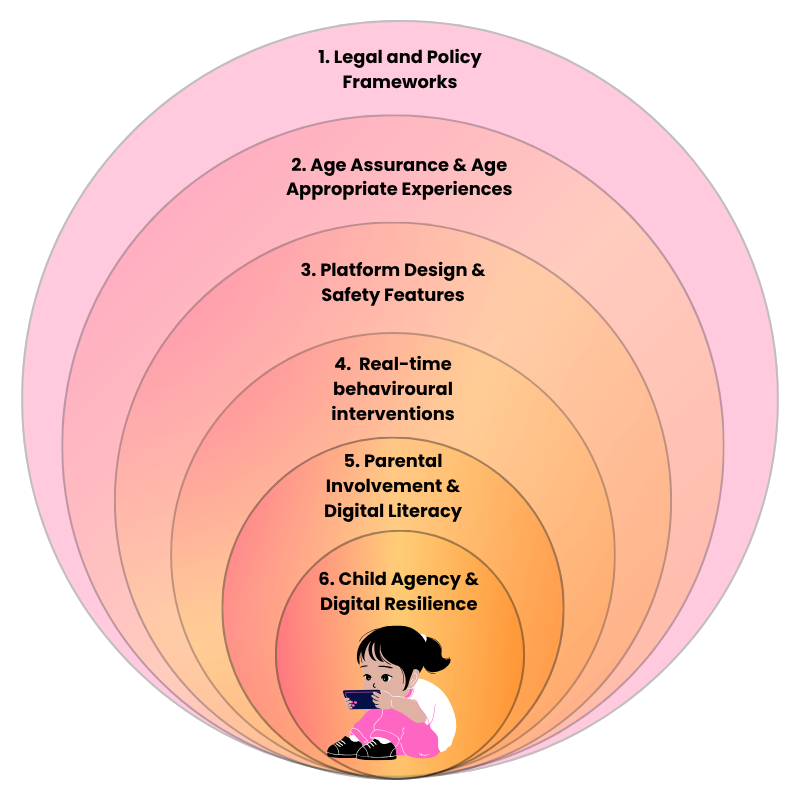
The same logic applies to protecting children online. Here are the six layers.
Layer one is legal and policy frameworks. This is the outer ring. Governments, regulators, legislation. The Online Safety Act, the Digital Services Act, COPPA, the Australian minimum age law. These create the obligation. They say platforms must act. But regulation alone does not protect anyone. It creates the conditions for protection. Without enforcement and without the technology to comply, legislation is just words on paper.
Layer two is age assurance and age-appropriate experiences. This is where most of the industry conversation lives right now, and it is where Neon Guard operates. The question of how you determine a user’s age and how you serve them content appropriate to that age. This layer is necessary but not sufficient on its own, which is a point the industry often misses. An age gate that works perfectly at the front door still leaves a child unprotected if the platform behind it is poorly designed.
Layer three is platform design and safety features. How the platform itself is built. Default privacy settings, content moderation, restricted modes, algorithmic choices about what gets surfaced and to whom. TikTok’s screen time prompts sit here. Instagram’s teen accounts sit here. These are design decisions baked into the product that reduce risk regardless of whether the age check was perfect. Good platform design is a safety layer in its own right.
Layer four is real-time behavioural interventions. What happens when something changes during a session. A flag is triggered. Content is restricted. A notification is sent to a parent. This is where continuous monitoring matters. Not just checking age at the door, but responding dynamically when behaviour shifts in ways that suggest the person behind the screen may not be who the system thinks they are.
Layer five is parental involvement and digital literacy. Parents, carers, educators. Setting boundaries, having conversations, understanding the risks and the tools available. Parental controls sit here. Family discussions about online behaviour sit here. This layer is important, but it has limits. You cannot parent your way out of a structural problem, and expecting families to compensate for platform failures is neither fair nor realistic.
Layer six is child agency and digital resilience. The child at the centre. Teaching children to recognise risk, make good decisions, understand consent and privacy, and advocate for their own safety. This is the long-term layer. It is about building a generation of young people who are equipped to navigate digital spaces, not just shielded from them.
How the layers work together
No single layer is sufficient. That is the whole point. But together they create a system where gaps in one layer are caught by another.
If regulation is slow, platform design can compensate. If an age gate is imperfect, real-time behavioural monitoring adds a safety net. If a parent is not technically literate enough to set up controls, a well-designed platform protects the child anyway. If all the technology in the world fails, a digitally resilient child has the tools to recognise and respond to risk.
The analogy I use most often comes from my cybersecurity background. In security, we have defence in depth. In online safety, we now have Layers of Care. The principle is identical: no single control is enough, and the system is only as strong as its weakest layer.
Where Neon Guard fits
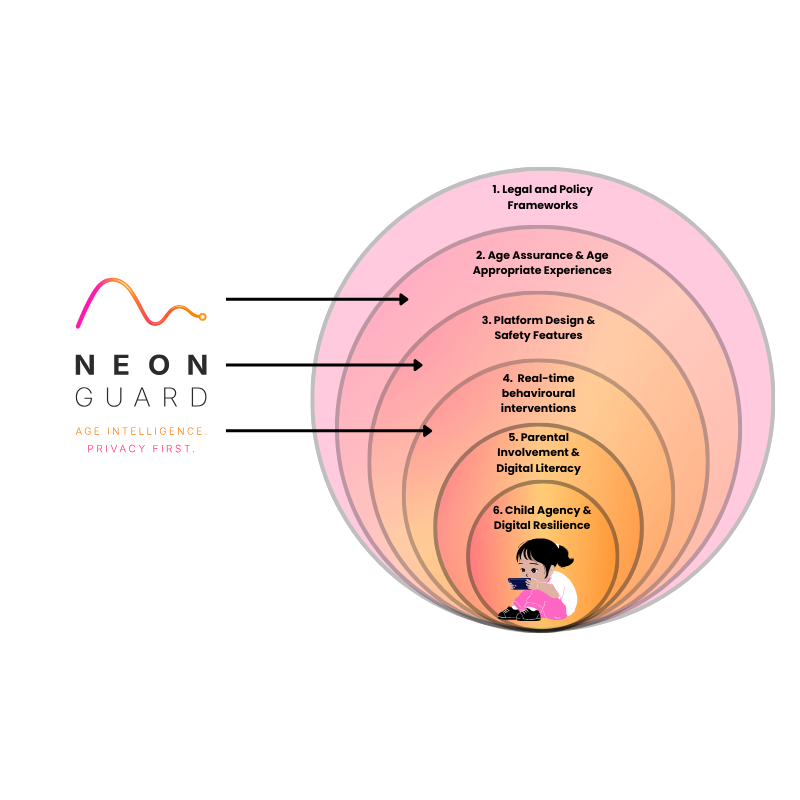
Neon Guard operates across multiple layers. In layer two we provide identity-free age assurance with no ID and no facial scan. But our continuous monitoring capability, what we call Age Drift Detection, also feeds into layers three and four. It gives platforms the ability to respond dynamically when confidence in a user’s age changes over time, which is a capability that does not exist in one-off age checks.
This is deliberate. We built Neon Guard to fit within a layered system, not to replace one. Anyone who tells you their technology is the complete answer to children’s safety online is either confused about the problem or not being straight with you. The problem is too complex for a single solution.
Why frameworks matter
It is tempting to skip the theory and jump straight to building technology. I understand the impulse. But frameworks matter because they shape how we think about problems, and how we think about problems determines what solutions we build.
If you think online safety is a gate problem, you build a better gate. If you think it is a systems problem, you build layers. The children who benefit from our work deserve the systems approach, not the shortcut.
The internet was not designed with children’s safety in mind. Fixing that is not a single feature or a single product. It is a commitment to building layered, thoughtful, privacy-respecting systems that treat safety as an ongoing responsibility rather than a one-time check.
That is what Layers of Care is about. And it is why Neon Guard exists.
If you want to find out more about Neon Guard, get in touch.